A Province is a Province?
By Anthony | September 8th, 2006 | 12:20 amSupporters of the Bush administration’s handling of the Iraq war often dispute the notion that things aren’t going well in Iraq. One argument you may see is something to the effect of “3 of 18 provinces have problems, the rest are relatively untouched.” An article about a recent DOD report echoed that statistic, saying:
Most of the attacks are in only four of the 18 provinces, the report notes. Fourteen provinces remain fairly peaceful and in one – Muthanna in the south –no coalition forces are operating.
Does this really give the whole story though?
A GAO paper from earlier this year suggests there may be more to stability than simply looking at where the attacks are occurring. According to this paper, the stability of 6 of Iraq’s provinces is in serious condition, and 1 province is in critical condition. The remaining provinces are in either moderate or stable condition.
Why the disparity? The paper cites a report made by the U.S. Embassy and the Multi-National Force in Iraq (MNF-I – this is our coalition in Iraq, so they certainly have first-hand knowledge of the situation there). The MNF-I paper identifies three components to assessing stability: Governance, Security, and Economics. When taking a broader view of things and considering those factors, it appears that more than three or four provinces in Iraq are having trouble.
Of course, even if we just look at the simple metric of where most of the attacks are happening, saying “only four provinces are having problems” is highly misleading. Four out of 18 doesn’t sound like much. Here’s what it looks like:

A bit less than a quarter of Iraq, right? Maybe not. The first thing to note is which provinces are experiencing that violence. According to the earlier DOD report, the four most violent provinces are Anbar, Baghdad, Diyala, and Salah ad Din, accounting for about 81% of all attacks. Here’s a map of Iraq, with those provinces outlined in red:
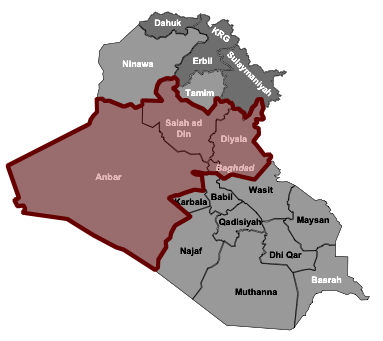
Not exactly an insignificant portion of the country, is it? In fact, those four provinces make up about 42% of Iraq’s geographical area. Here’s that pie chart again, this time with the slices proportioned according to geographical area (the four most violent provinces are highlighted):

Of course, one could argue that just because a province is large doesn’t mean that it contains a large population of people who may be affected by the violence. However, it turns out that the “four out of 18” meme is a bit misleading here as well. According to the earlier DOD report, the four provinces in question contain about 37% of Iraq’s population. Turning again to our pie chart:

Still looks like a considerably larger chunk of the country than one would be led to believe by saying “only” four provinces have it bad. Baghdad alone (the large slice in the red area) contains around six and a half million people.
None of this is to say that we shouldn’t be in Iraq, or that the situation is hopeless. Rather, I think that if we are going to improve the situation, and make a meaningful and positive difference in Iraq, we need to have a realistic assessment of the situation. That means not minimizing the problems by dismissing them as being confined to “only” a few provinces. As one commenter named Penguin recently said on the blog Noteworthy, “I am certain that even during the height of the civil war, people in Connecticut were going about their daily business. That doesn’t detract from the real fact that thousands were dying in a war 500 miles away.”
I’m sure that there are areas of Iraq that are getting along fairly well. But no matter how you slice it, the situation there is serious and shouldn’t be brushed aside.

September 8th, 2006 at 9:39 pm
Anthony, great post. Of course, the ongoing question has always been– What is the best course of future action?
September 9th, 2006 at 9:35 am
You’re beating your dead horse again, Stew.
By the way, where’s you’re post of outrage about the attack on ABC’s first amendment rights by the Clintonistas/Dems/Nutrooters?
You must have just been too busy to get around to it, right?
September 10th, 2006 at 11:18 pm
Hi Joe – thanks for the kind words. I agree that your question is a very important one. The answer is definitely not “stay the course” in my opinion. I think the “best” course is probably to increase the number of troops we have there (though I don’t see anyone getting the political will to do that), and somehow, some way get other nations invoved (though I’m not sure how likely that is at this point). It’s definitely a tough situation we’ve put ourselves in.
September 10th, 2006 at 11:27 pm
Bubba,
“You’re beating your dead horse again, Stew.”
I’ve only made this analysis one other time, as a comment a few days ago, so I’m not sure how this qualifies as beating any horses. Feel free to ignore it if you don’t have any actual response to my arguments.
“By the way, where’s you’re post of outrage about the attack on ABC’s first amendment rights by the Clintonistas/Dems/Nutrooters? You must have just been too busy to get around to it, right?”
Actually, I was away for the weekend, which is why I haven’t posted or commented anywhere since Friday – so yes, I have been busy. At any rate, that’s totally off topic.