Congressional Corruption

By Anthony | September 20th, 2006 | 1:17 pm

“Suppose you were an idiot. And suppose you were a member of Congress. But I repeat myself.” – Mark Twain

Citizens for Responsibility and Ethics in Washington has released a report on the 20 most corrupt members of Congress. You can read the full report at their site, or click on a name in the list for a handy summary.

Unfortunately, one of our own made the list – Rep. Charles Taylor (R).

(Hat tip: Ed Brayton)

From Meme to You

By Anthony | September 19th, 2006 | 11:27 pm

I haven’t ever participated in one of these memes before, but then again, I’ve never been asked. Now I find that Billy has tagged Joel and Joel has tagged me. So here are the questions, and my answers:

1: Do you like the look and the contents of your blog?

Yes. There are some tweaks I have in mind for it, polishing a few rough edges, but I haven’t had a chance to work on them yet. Overall though, I’m happy with how it’s turned out so far.

2: Does your family know about your blog?

A few do – my wife does. My Mom does as well, but she doesn’t go on the Internet and so she hasn’t read it (though she has seen some of my cartoons).

3: Can you tell your friends about your blog? Do you consider it a private thing?

I could, but I don’t for the most part. My wife tells more people about it than I do, I think. It’s not that I consider it private, it’s just that I’m not generally known for offering much in the way of personal information.

4: Do you just read the blogs of those who comment on your blog? O do you try to discover new blogs?

I read quite a few blogs, but most of them don’t comment on mine. I don’t go out of my way to specifically try to discover new blogs, but if I happen across one I’ll often take a look through it.

5: Did your blog positively affect your mind? Give an example.

Yes, for the most part. I enjoy critical thinking and debating, so I get plenty of that. A specific example would be that it encourages me to keep up with current events, particularly local ones that I otherwise might not pay much attention to. Before I moved to North Carolina I lived in Delaware, and I had no clue as to what was really going on locally, or what the politics of the area were like. It’s been a totally different story down here since I started reading local blogs and blogging myself.

6: What does the number of visitors to your blog mean? Do you use a traffic counter?

I do use one, and I look at it at regular intervals, though not too frequently. I don’t expect to ever have a ton of traffic, but it makes me happy to know that there’s a steady (though relatively small) number of people coming through. Of course, I feel bad for many of them, because according to my traffic counter, a lot of them are finding me through this post when they’re doing a search for “how much money does a fireman make”, and unfortunately for them, the post doesn’t actually answer that question.

7: Did you imagine how other bloggers look like?

I sometimes try to imagine how old they might be, or what sort of background they come from, but not really what they look like.

8: Do you think blogging has any real benefit?

Absolutely. As I mentioned before, it’s helped me to be more engaged with what’s going on locally. It’s a great way to communicate ideas and information, if you can get past some of the noise out there.

9: Do you think that the Blogsphere is a stand alone community separated from the real world?

That seems kind of like asking if a book club is a stand alone community separated from the real world. It’s part of the real world – a subset of it.

10: Do some political blogs scare you? Do you avoid them?

Scare? No. Annoy? Yes.

11. Do you think that criticizing your blog is useful?

Depends on the criticism I suppose.

12: Have you ever thought about what happen to your blog in case you died?

Not particularly. I would hope that it would pick up the pieces and carry on without me, but perhaps that’s a bit unrealistic. More likely you would find it downtown drinking heavily and picking fights with other blogs.

13: Which blogger had the greatest impression on you?

Probably Ed Cone since he’s been such a supporter of the local blogging community, and of blogging in general.

14: Which blogger you think is the most similar to you?

I don’t know – it depends on what sort of criteria you’re looking at. Subject matter? Style? Personality? You’d get a different answer depending on what you focus on.

15: Name a song you want to listen to.

Something by The Frames. How about Lay Me Down.

16: Ask five bloggers to answer these question on their blogs.

Chip
Cara Michele
Sam
Brenda
David Boyd – He answered it once already, but I’m going to insist that he answer it a second time since he was such a fuddy duddy the first time.

Cartoon: In Need of a Retread

By Anthony | September 19th, 2006 | 8:23 am

Cartoon: In Need of a Retread

White’s Tire Service, formerly the recipient of all North Carolina’s school bus tire repair work, has taken some heat for what appears to be a habit of overcharging for repairs. As a result, the state is changing how it handles those contracts.

Battle Lines

By Anthony | September 13th, 2006 | 1:17 am

Ed Brayton has a great post up at Dispatches From the Culture Wars. It deals with the way people draw unnecessary battle lines based on attributes such as religion, when in reality we often find that many of the truly important issues tend to make those battle lines irrelevant and even harmful. One passage stood out in particular:

I think we spend entirely too much time and energy drawing the lines in the wrong place. Too many people are focused on dividing us up into all the wrong groups. Humans are tribal by nature, I think, but as the world has shrunk we’ve developed the ability to form intentional tribes rather than tribes of necessity (family, village, etc). But we still tend to distinguish Us versus Them based on the most superficial of characteristics. The lines shouldn’t be drawn between Christians and atheists, Jews and Muslims, and so forth; they should be drawn between the decent and intelligent and life-embracing people in every group and the bigoted, ignorant and reactionary people in every group.

Brayton is primarily addressing religious divisions, but I think his reasoning should be extended even to political divisions when possible. It seems to me that the best possible thing would be for reasonable people from both sides of the spectrum to look past political affiliation and push back together against knee-jerk irrationality. Easier said than done, of course, and maybe even impossible with some issues. But it’s good to be reminded to question the layout of our battle lines, and to consider redrawing them from time to time when warranted.

ConvergeSouth Promo Video

By Anthony | September 12th, 2006 | 12:29 am

ConvergeSouth is coming soon. Ben asked if I’d be interested in creating a short promo video for it. At first I said “no” because while I enjoy making home movies, I’d never made a video that didn’t involve small babies and family members. Eventually, I decided to give it a try. Here’s the result:

I’m not entirely happy with the way YouTube compressed the video. Ben did a much nicer job, which can be seen on the ConvergeSouth media server.

For those interested in this sort of thing, the footage was shot on my Canon MiniDV Camcorder and edited with FinalCut Express. I had to retouch a couple dozen frames by hand in Photoshop to remove some dust that was in the frame (that’s what I get for shooting through my car windshield). The two still-photos in the middle are courtesy of Sue. The soundtrack was arranged in GarageBand.

Cartoon: Structural Repairs

By Anthony | September 11th, 2006 | 10:51 pm

Cartoon: Structural Repairs

The costs are adding up. Several Guilford County schools have been found to be in need of repairs, apparently due to flawed design work by Hermon Fox, a retired Greensboro engineer.

A Province is a Province?

By Anthony | September 8th, 2006 | 12:20 am

Supporters of the Bush administration’s handling of the Iraq war often dispute the notion that things aren’t going well in Iraq. One argument you may see is something to the effect of “3 of 18 provinces have problems, the rest are relatively untouched.” An article about a recent DOD report echoed that statistic, saying:

Most of the attacks are in only four of the 18 provinces, the report notes. Fourteen provinces remain fairly peaceful and in one – Muthanna in the south –no coalition forces are operating.

Does this really give the whole story though?

A GAO paper from earlier this year suggests there may be more to stability than simply looking at where the attacks are occurring. According to this paper, the stability of 6 of Iraq’s provinces is in serious condition, and 1 province is in critical condition. The remaining provinces are in either moderate or stable condition.

Why the disparity? The paper cites a report made by the U.S. Embassy and the Multi-National Force in Iraq (MNF-I – this is our coalition in Iraq, so they certainly have first-hand knowledge of the situation there). The MNF-I paper identifies three components to assessing stability: Governance, Security, and Economics. When taking a broader view of things and considering those factors, it appears that more than three or four provinces in Iraq are having trouble.

Of course, even if we just look at the simple metric of where most of the attacks are happening, saying “only four provinces are having problems” is highly misleading. Four out of 18 doesn’t sound like much. Here’s what it looks like:

Provinces

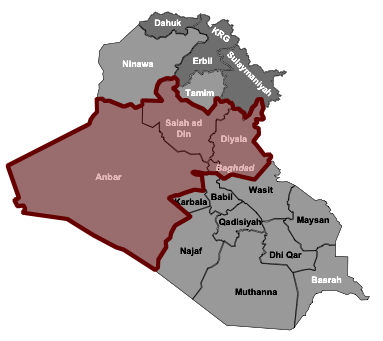
A bit less than a quarter of Iraq, right? Maybe not. The first thing to note is which provinces are experiencing that violence. According to the earlier DOD report, the four most violent provinces are Anbar, Baghdad, Diyala, and Salah ad Din, accounting for about 81% of all attacks. Here’s a map of Iraq, with those provinces outlined in red:

Iraq

Not exactly an insignificant portion of the country, is it? In fact, those four provinces make up about 42% of Iraq’s geographical area. Here’s that pie chart again, this time with the slices proportioned according to geographical area (the four most violent provinces are highlighted):

Provinces by area

Of course, one could argue that just because a province is large doesn’t mean that it contains a large population of people who may be affected by the violence. However, it turns out that the “four out of 18” meme is a bit misleading here as well. According to the earlier DOD report, the four provinces in question contain about 37% of Iraq’s population. Turning again to our pie chart:

Provinces by population

Still looks like a considerably larger chunk of the country than one would be led to believe by saying “only” four provinces have it bad. Baghdad alone (the large slice in the red area) contains around six and a half million people.

None of this is to say that we shouldn’t be in Iraq, or that the situation is hopeless. Rather, I think that if we are going to improve the situation, and make a meaningful and positive difference in Iraq, we need to have a realistic assessment of the situation. That means not minimizing the problems by dismissing them as being confined to “only” a few provinces. As one commenter named Penguin recently said on the blog Noteworthy, “I am certain that even during the height of the civil war, people in Connecticut were going about their daily business. That doesn’t detract from the real fact that thousands were dying in a war 500 miles away.”

I’m sure that there are areas of Iraq that are getting along fairly well. But no matter how you slice it, the situation there is serious and shouldn’t be brushed aside.

Insight Into School-Sanctioned Prayer

By Anthony | September 6th, 2006 | 12:35 am

In the recent conversations I’ve had about the West Virginia lawsuit involving the portrait of Jesus, as well as other discussions revolving around schools and religion, the opinion is often expressed that school prayer should be ok, and that school-sanctioned religious displays don’t harm anyone.

However, many people disagree with that sentiment, including some evangelical Christians. A letter last year to WorldNetDaily has one such evangelical speaking from his own experiences and making the case against school prayer. The man was living in Hawaii with his family, in a small town that was predominently Buddhist, where Christians were in the minority:

Because we worked in the youth department of our church and taught teenage Sunday School classes, we were anxious to be involved in the lives of the students we worked with. So we were quite excited to be able to attend our first football game at Wahiawa High School…

Coming from a fairly traditional Southern upbringing, I was not at all initially surprised when a voice came over the PA and asked everyone to rise for the invocation. I had been through this same ritual at many other high-school events and thought nothing of it, so to our feet my wife and I stood, bowed our heads, and prepared to partake of the prayer. But to our extreme dismay, the clergyman who took the microphone and began to pray was not a Protestant minister or a Catholic priest, but a Buddhist priest who proceeded to offer up prayers and intonations to god-head figures that our tradition held to be pagan.

We were frozen in shock and incredulity! What to do? To continue to stand and observe this prayer would represent a betrayal of our own faith and imply the honoring of a pagan deity that was anathema to our beliefs. To sit would be an act of extreme rudeness and disrespect in the eyes of our Japanese hosts and neighbors, who value above all other things deference and respect in their social interactions.

We often advocate the practice of Judeo-Christian rituals in America’s public schools by hiding behind the excuse that they are voluntary and any student who doesn’t wish to participate can simply remained seated and silent. Oh that this were true. But if I, as a mature adult, would be so confounded and uncomfortable when faced with the decision of observing and standing on my own religious principals or run the risk of offending the majority crowd, I can only imagine what thoughts and confusion must run through the head of the typical child or teenager, for whom peer acceptance is one of the highest ideals.

In his letter, the writer states that because of this, he stopped going to the high school football games. Students, however, won’t usually have the option of removing themselves from the situation.

(Hat tip: Pharyngula)

Cartoon: Help Wanted

By Anthony | September 4th, 2006 | 1:02 pm

Cartoon: Help Wanted

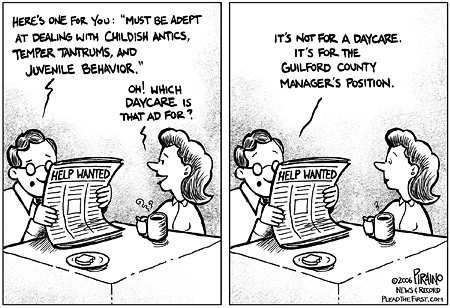
Guilford County seems to be having some trouble attracting a large number of applicants for the county manager’s position. I wonder why?

The Pope and Evolution (and Hitler)

By Anthony | August 31st, 2006 | 10:09 pm

Nancy over at the Front Pew links to this Washington Post article and asks, “Will Pope Benedict XVI embrace Intelligent Design?”

The author of the WaPo article seems to think that its a possibility, saying:

Schoenborn, a close associate of Benedict, raised eyebrows last year with an article in the New York Times suggesting the Catholic Church supported the Intelligent Design movement.

He did not endorse it outright, but agreed with the ID movement’s view that scientists who say evolution rules out God draw an ideological conclusion not proven by the theory.

Benedict has argued this way since his teaching days. At his inaugural mass after his election last year, he declared: “We are not some casual and meaningless product of evolution. Each of us is the result of a thought of God.”

However, one can agree that “scientists who say evolution rules out God draw an ideological conclusion not proven by the theory” without disputing the truth of evolutionary theory. It would be impossible for the theory of evolution – or any other scientific discipline – to “rule out God” in the sense of disproving his existence. Science deals with the natural world, and can’t comment one way or the other on the supernatural. Of course, scientists need to behave as if the supernatural does not exist while they are practicing science, but that’s not the same thing as disproving the supernatural.

An article at Time.com today also seems skeptical that there will be any papal endorsement of Intelligent Design:

Benedict XVI will indeed be hosting a scholarly pow wow this weekend at his summer residence at Castel Gandolfo, south of Rome, to debate evolution and creation. But don’t expect the Catholic Church to start disputing Darwin’s basic findings, which Pope John Paul II in 1996 called “more than a hypothesis.” Moreover, advocates of the teaching in U.S. schools of intelligent design — which holds that nature is so complex that it must be God’s doing — should not count on any imminent Holy See document or papal pronouncement to help boost their cause. This weekend’s private retreat is an annual gathering of the Pope’s former theology students to freely discuss one topic of interest, without the aim of reaching any set conclusion.

Somewhat related: Nancy also recently posted about Coral Ridge Ministries attempts to link Darwin’s ideas to Hitler’s madness, leading to a lengthy discussion in the comments there. What such a theory neglects to consider is that Hitler also used the Bible and Chrisitanity to argue for his worldview, yet I’m sure Coral Ridge wouldn’t claim that Christianity led to the holocaust.